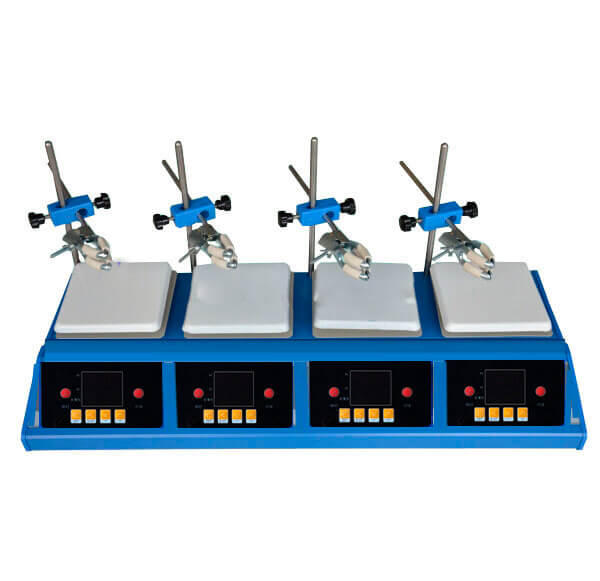
ISO/IEC Standards and Regulatory Compliance in Laboratory Equipment: A Focus on Multiposition Intelligent Digital Display Ceramic Hotplate Stirrers
The laboratory equipment industry is governed by a variety of ISO and IEC standards that ensure quality, safety, and efficiency. Among these standards, the compliance of multiposition intelligent digital display ceramic hotplate stirrers is crucial for laboratories aiming to enhance their operational productivity while adhering to regulatory requirements. This article will delve into how different models of multiposition hotplate stirrers align with ISO/IEC norms, providing a comparative analysis of various models and their unique specifications tailored for laboratory professionals.
Understanding ISO/IEC Standards for Laboratory Equipment
ISO (International Organization for Standardization) and IEC (International Electrotechnical Commission) standards outline essential requirements for laboratory equipment, ensuring safety and reliability. Compliance with ISO 17025, which focuses on testing and calibration laboratories, is particularly relevant for hotplate stirrers. This standard emphasizes the importance of maintaining quality management systems and technical competence, which are critical in ensuring accurate and reproducible results in laboratory experiments.
Comparison of Available Models
| Model Code | ISO/IEC Clauses Covered | Traceability Features | Best For |
|---|---|---|---|
| YR02953 | ISO 17025 | Digital temperature display | Multiple sample processing |
| YR02954 | ISO 17025 | Digital speed control | High precision applications |
| YR02955 | ISO 17025 | PID temperature control | Laboratories requiring high throughput |
| YR02947 | ISO 17025 | Digital readouts | Small batch processing |
| YR02948 | ISO 17025 | External thermometer support | Biological and chemical applications |
| YR02949 | ISO 17025 | Not specified | Standard laboratory tasks |
Benefits of Compliance with ISO/IEC Standards
Compliance with ISO/IEC standards not only enhances the reliability and safety of laboratory equipment but also boosts the laboratory’s credibility. For instance, a hotplate stirrer like the YR02953, which complies with ISO 17025, ensures that consistent quality management processes are in place. This helps laboratories demonstrate their capability to produce valid and reliable results, ultimately leading to better customer trust in their findings.
Common Mistakes and How to Avoid Them
One common mistake in laboratories is the assumption that equipment compliance is a one-time setup. In reality, ongoing compliance requires regular audits, maintenance, and calibration. For hotplate stirrers, like the YR02955, it is vital to establish a routine calibration plan to ensure consistent performance. Additionally, neglecting documentation can lead to regulatory issues; hence, maintaining detailed records of usage, maintenance, and calibration is crucial.
Exploring Regulatory Compliance for Hotplate Stirrers
Regulatory compliance for hotplate stirrers involves ensuring that the equipment meets specific safety and performance criteria. The IEC 61010 standard, which focuses on safety requirements for electrical equipment for measurement, control, and laboratory use, is particularly relevant. Models like the YR02954 are designed with safety measures that align with this standard, ensuring that both users and the equipment are protected during operation.
Traceability and Documentation Requirements
Maintaining traceability in laboratory operations is vital for ensuring compliance with ISO standards. For hotplate stirrers, this involves documenting calibration and maintenance activities to demonstrate adherence to operational standards. The YR02948, for instance, offers features that support traceability through digital displays that log temperature and speed settings, assisting in the audit process.
Key Features Supporting Compliance
Each model of multiposition intelligent digital display ceramic hotplate stirrers has features that specifically aid in compliance with ISO/IEC standards. For example, the PID temperature control in the YR02955 helps ensure that temperature stability is maintained within the specified limits, critical for processes outlined in ISO 17025.
Frequently Asked Questions
How can I ensure my hotplate stirrer complies with ISO 17025 standards?
Regular calibration and maintenance are essential for compliance with ISO 17025 standards. Using models like the YR02953, which features PID control, can help maintain precise temperature and speed settings, ensuring compliance in testing environments.
What are the traceability features of digital display hotplate stirrers?
Digital display hotplate stirrers, such as the YR02954, often include features like digital readouts for speed and temperature, which enhance traceability by allowing precise monitoring and documentation of operational settings during experiments.
Which models are best for high-throughput laboratory applications?
The YR02955 is particularly well-suited for high-throughput applications due to its ability to handle multiple samples simultaneously while maintaining compliance with ISO 17025, ensuring reliable results.
How do I document compliance for my laboratory equipment?
Compliance documentation should include maintenance logs, calibration certificates, and operational records. Using models like YR02948 that support digital logging can simplify this process and enhance accuracy in maintaining compliance.
What role does PID control play in laboratory hotplate stirrers?
PID control, as seen in the YR02955, ensures stable temperature management, which is crucial for meeting ISO standards like ISO 17025, where precise temperature control affects the reproducibility of experimental results.
How frequently should hotplate stirrers be calibrated for compliance?
Calibration frequency can vary, but it is recommended to calibrate hotplate stirrers, like the YR02953, at least annually or after any maintenance to ensure ongoing compliance with ISO 17025 standards.
What are the safety standards applicable to hotplate stirrers?
The IEC 61010 standard outlines the safety requirements for laboratory equipment, ensuring that models like the YR02954 are designed to minimize risks to users while operating under various conditions.
What features make hotplate stirrers suitable for biological applications?
Hotplate stirrers that offer adjustable speed and temperature settings, such as the YR02948, are ideal for biological applications where precise control is necessary for experimental integrity and compliance with laboratory standards.
If you are looking for a fusion of innovation and quality, you have come to the right place. At Kalstein, we offer you the luxury of exploring our exclusive catalog of laboratory equipment. We manufacture every device to the highest standards of excellence. Our intuitive and seamless online purchasing channels are designed for your convenience, securing the most competitive prices. Hesitate no longer — we bring science to life, it is time to become part of our community.